The Rise and Decline of Nations: Economic Growth, Stagflation, and Social Rigidities by Mancur Olson
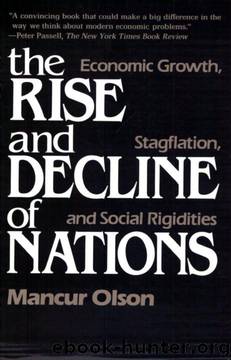
Author:Mancur Olson [Olson, Mancur]
Language: eng
Format: epub
Published: 0101-01-01T00:00:00+00:00
When testing any theory, it is by no means enough to find a few cases that seem to support it. If the predictions of the theory apply to a large number of cases and only a small number of those cases are discussed, then there is always the possibility that only those cases that happen to be consistent with the theory have been considered and that a thorough analysis of the available evidence would indicate that the theory was false. Unfortunately, the present theory has implications for such an incredibly wide array of phenomena in different countries and historical periods that a thorough and meticulous testing is out of the question here. It would not only make this book impossibly long, but it would also require vastly more knowledge than I have or could hope to acquire. There is, however, protection against the possibility that I have considered only unrepresentative cases in the fact that we have looked at the growth rates of all of the developed democracies in the years since regular estimates of national income were first prepared, shortly after World War II (see table 1. 1, p. 6 above). Thus, so far as the postwar developed democracies are concerned, there is no possibility that only those cases that happen to fit the theory have been considered. It may be a matter of dispute whether the theory is consistent with all of the major variations in growth rates in this subset or just with most of them, but since the importance of other causal factors is emphasized, there is some support for the theory in the postwar experience of the developed democracies on even the most skeptical reading of this evidence.
It is, on the other hand, still possible that the developed democracies since the war are unrepresentative in ways that are crucial to deciding what claim to credence, if any, the theory has. One real pos sibility is that the data on these countries fit the argument purely by chance, although the collateral evidence on industry comparisons and temporal patterns of growth and the mass of corroborative data on the forty-eight states make this extraordinarily unlikely. Another possibility is that there is some altogether different causal mechanism operating that has much the same results as the theory here predicts. A third possibility is that the theory is true or largely true for these countries but does not apply to other types of societies, such as the developing nations or the communist countries.
There is some protection against all these possibilities in the way the theory appears to fit the experience of Britain, Holland, and France in the early modern period, the patterns of growth within European countries in that period, and the growth of the United States and Germany in the nineteenth century. Indeed, as we shall see in the last chapter, the theory is consistent with some dramatic features of the interwar period also, so the claim that it fits the most striking departures from normal economic experience among the nations of the West since the late Middle Ages has some basis.
Download
This site does not store any files on its server. We only index and link to content provided by other sites. Please contact the content providers to delete copyright contents if any and email us, we'll remove relevant links or contents immediately.
International Integration of the Brazilian Economy by Elias C. Grivoyannis(111452)
The Radium Girls by Kate Moore(12112)
Turbulence by E. J. Noyes(8143)
Nudge - Improving Decisions about Health, Wealth, and Happiness by Thaler Sunstein(7774)
The Black Swan by Nassim Nicholas Taleb(7218)
Rich Dad Poor Dad by Robert T. Kiyosaki(6772)
Pioneering Portfolio Management by David F. Swensen(6354)
Man-made Catastrophes and Risk Information Concealment by Dmitry Chernov & Didier Sornette(6158)
Zero to One by Peter Thiel(5891)
Secrecy World by Jake Bernstein(4821)
Millionaire: The Philanderer, Gambler, and Duelist Who Invented Modern Finance by Janet Gleeson(4552)
The Age of Surveillance Capitalism by Shoshana Zuboff(4374)
Skin in the Game by Nassim Nicholas Taleb(4321)
The Money Culture by Michael Lewis(4273)
Bullshit Jobs by David Graeber(4267)
Skin in the Game: Hidden Asymmetries in Daily Life by Nassim Nicholas Taleb(4069)
The Dhandho Investor by Mohnish Pabrai(3838)
The Wisdom of Finance by Mihir Desai(3805)
Blockchain Basics by Daniel Drescher(3651)
